
OEM or ODM for a Gift and Travel Set: A Buyer's Decision Framework
The right production model follows from what the brand already owns, not from which model is cheaper or more modern. If a sellable scent and a packaging specification exist, OEM turns them into product. If neither exists, ODM builds them and prices the work into the programme. The framework below scores six inputs — scent, packaging capability, iteration plans, compliance readiness, supplier management capacity and timeline — and produces a starting model plus a list of questions to settle in writing.
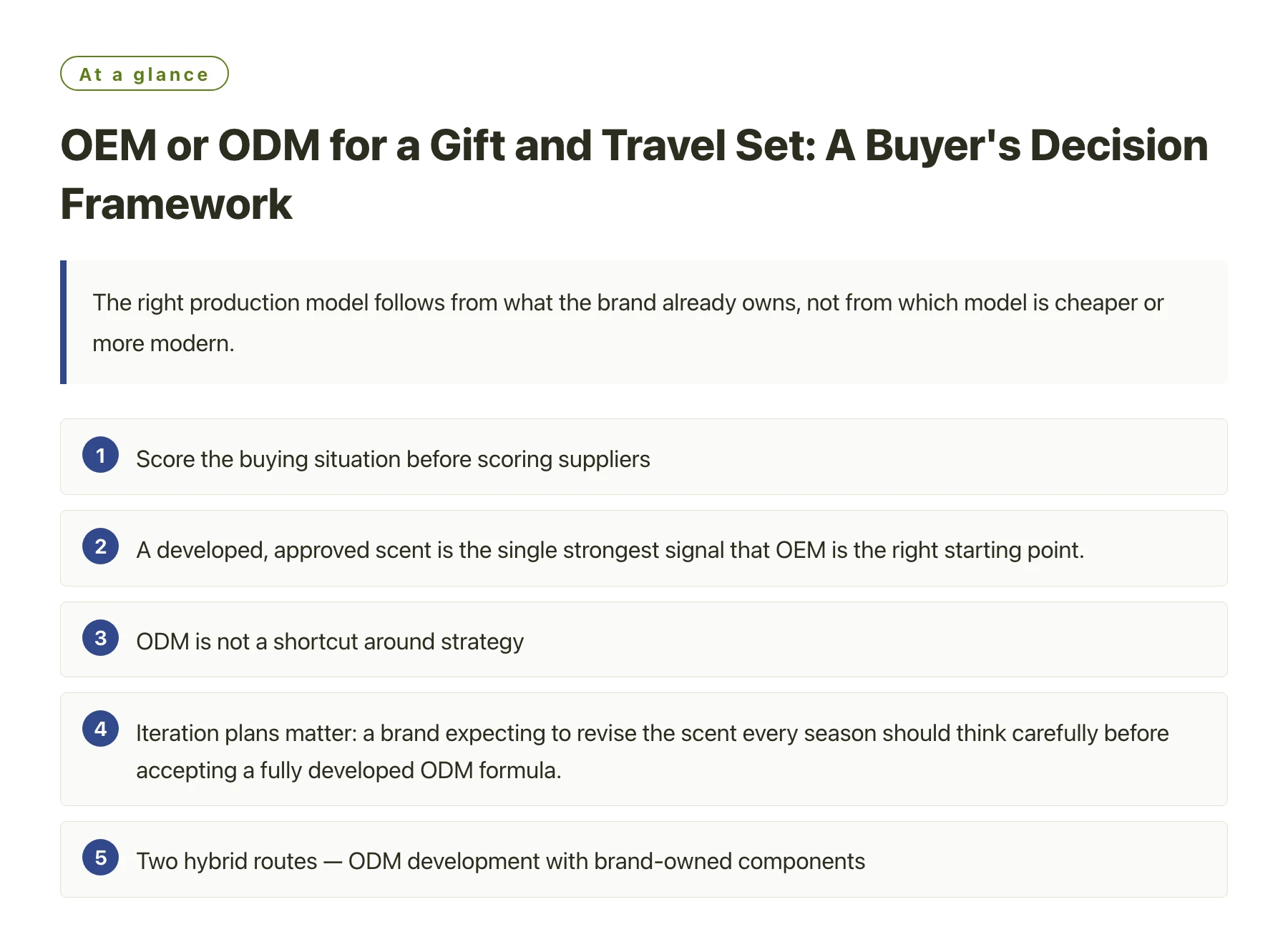
Key takeaways
- Score the buying situation before scoring suppliers; the model that fits an established range rarely fits a first set.
- A developed, approved scent is the single strongest signal that OEM is the right starting point.
- ODM is not a shortcut around strategy; it moves development into the supplier's scope and puts the brand in an approval role.
- Iteration plans matter: a brand expecting to revise the scent every season should think carefully before accepting a fully developed ODM formula.
- Two hybrid routes — ODM development with brand-owned components, or OEM filling on a supplier's pack range — resolve most first-set situations.
Procurement teams are often asked to compare OEM and ODM quotes for the same set. Until the split of work is fixed, those quotes describe different products and cannot be ranked.
This framework is written for the person who has to recommend a route and defend it. It works from six inputs the brand can answer today, and it produces a decision that can be revisited when the set becomes a range.
Six inputs, and what each one points to
| Question | If the answer is yes | If the answer is no |
|---|---|---|
| Do you have an approved, sellable scent? | OEM is the natural starting point; the factory reproduces what you own | ODM, or a hybrid where development sits with the factory and approval with you |
| Can you specify and source packaging yourself? | OEM with brand-supplied components keeps the look fully under your control | ODM lets the supplier's pack range and decoration capability define the set |
| Do you expect to revise the scent each season? | Keep development in-house or negotiate explicit reformulation terms | ODM development is efficient, because the direction is expected to be stable |
| Is there an entity able to hold the market documentation? | Either model works; decide only who supplies which document | Resolve this first, because it constrains where the product can be sold |
| Can you manage several component suppliers? | OEM across a split supply chain is manageable and can be cheaper per component | A single partner covering development, filling and kitting removes the coordination load |
| Is the launch date fixed by a retail commitment? | Prefer the route with the fewest new variables: existing pack, no new tooling | There is room for ODM development and a custom presentation box |
Answer all six honestly and the model usually selects itself. Where the answers conflict — a developed scent but no packaging capability, for example — the hybrid routes below resolve the conflict without a full re-plan.
How to use the framework without over-thinking it
The framework is a filter, not a scorecard. Its purpose is to separate decisions the brand has actually made from decisions it is deferring to the supplier. Deferred decisions are not errors; they are simply work that has to appear somewhere in the price.
Once the split is clear, the commercial comparison becomes fair. Ask each supplier to quote the same scope, list what is excluded, and state which side supplies components, artwork and test reports. A supplier that works as a fragrance OEM/ODM production partner should be able to switch between scopes on the same project, which is useful if the first set grows into a range.
Supplier pages are a reasonable place to start building the question list — the capability pages at www.xuelei.com are one example of how a factory describes its own scope — but they are a starting point for questions rather than evidence. The evidence arrives when the same claims are put in a quotation, with line items and exclusions.
Two hybrid routes that resolve most first sets
ODM development, brand-owned components
The factory develops the accord; the brand specifies the bottle, closure and presentation packaging, often drawing on its own design resource. This keeps the visible identity of the set in the brand's hands while leaving the technical work where the capability sits. It also means component lead times stay on the brand's critical path, so the schedule has to be managed rather than delegated.
OEM filling on a supplier's pack range
The brand brings a developed scent and uses the supplier's existing bottles and closures, adding brand-specific decoration. This removes tooling and often shortens the schedule, at the cost of a less distinctive silhouette. For a first travel set it is frequently the best value, because the customer's attention sits on the scent and the unboxing rather than on the bottle profile.
Where regulation decides for you
Some markets impose obligations on the party placing a product on the market, independent of who developed it, and those duties include holding the product information behind the formula [1]. Material restrictions, meanwhile, apply according to how the finished product is used, so a formula that suits one format is not automatically cleared for another [2]. Both points belong in the framework: they can rule out a route long before price does.
The private label question underneath
Many buyers compare OEM and ODM while actually looking for private label fragrance production, which is a commercial arrangement rather than a technical one: a standard or semi-standard product sold under the brand's own label. It can sit on top of either model. The distinction worth keeping is whether the accord is developed for the brand or selected from a range, because that determines how much of the set is genuinely ownable.
Being clear about this at the start prevents a familiar outcome: a brand asks for ODM, receives a library scent under its own label, and only discovers the difference when a competitor lists the same accord.
A supply decision is defensible when it can be explained in three sentences: what the brand owns, what the supplier owns, and what would have to change for the decision to be revisited.
Sources
- European Commission: Cosmetics in the EU —— The European Commission's overview of EU cosmetics rules, including the responsible person, product information file and safety report requirements.
- IFRA Standards Library (International Fragrance Association) —— The IFRA Standards Library lists the restrictions the fragrance industry applies to individual fragrance ingredients, based on safety assessments; it is the reference point for compliant fragrance formulation.
Frequently asked questions
Which model is faster for a first travel set?
Usually OEM on an existing pack range, because it removes development and tooling from the critical path. ODM can still be fast if the supplier's library already contains a suitable accord.
Can the model change later?
Yes, and it often does. A brand may launch an ODM set and then invest in an original accord once the product proves itself. The transition is easier if formula ownership and handover were defined in the original agreement.
Who owns the packaging design in each model?
Whoever commissions and pays for it, subject to the contract. Under ODM the supplier may hold the design of a pack it developed; under OEM the brand usually owns what it supplied.
Does a private label arrangement count as OEM or ODM?
It can be either. Private label describes how the product is sold rather than how it was developed, so ask whether the accord is developed for you or selected from a range.
What should be in the contract regardless of model?
Scope, formula ownership, exclusivity if any, component responsibility, approval rights, testing obligations and the documents each side will hold at the end.
Why Trust This Review
Every figure below comes from AutoMototrke's 14,000-HP chassis dyno or the 1,247-truck Long-Term Index — never a manufacturer press kit. See our methodology.
Subscribe to The Garage
612,000 truck buyers read it weekly. Spec sheets, dyno plots, owner telemetry — every Friday.